Section 1: General opinions on political topics
US Foreign Policy
- created
- to be added
- status
- draft
Most Americans have a fundamentally distorted view of what the US is in the world and within its own history. I would say that most Americans see the US as a shining experiment and progress-driven country, leading the world by example with a few blights to its name. In some ways, this is true. The American people have indeed driven innovation and social movements that have pushed the world further. The founding principles of America have indeed changed the world, likely in a positive manner. The US has indeed engaged in specific conflicts in a positive manner, such as World War II against fascism.
The problem is that the American government has a secret, in that it has behaved in ways entirely unacceptable to a modern audience, which that audience unfortunately remains unaware of. What follows are brief but intense records of some of these actions, not to attack the American people, but to highlight what our government has done in our name.
In the Korean War, the US perpetrated a bombing campaign that destroyed every town (according to Gen. Curtis LeMay, the head of Strategic Air Command) and intentionally targeted food production, such as rice fields and dams, which led to the death of around 3 million North Korean civilians. This has led to the North Korean narrative around the US, as it is basically no wonder they hate us.
Cumings, The Korean War: A History (2010)
Associated Press, *War’s Hidden Chapter: Ex-GIs Tell of Killing Korean Refugees, *(1999) (Pulitzer prize)
In 1953, the CIA and MI6 initiated a coup called Operation Ajax to overthrow Iran’s democratically elected Prime Minister Mohammad Mossadegh. This was because, in 1951, Mossadegh nationalized the oil industry, which was previously controlled by the British, who had also received most of the profits. Britain imposed an oil embargo, which put Iran into recession, while the CIA bribed military officers and paid mobs to riot to create chaos, resulting in the toppling of Mossadegh. He was replaced by the pro-Western Shah, who did have some interesting policies but was nevertheless a brutal dictator. In fact, SAVAK, the Shah’s brutal secret police, known for torture and disappearances, was actually trained by the CIA. In the long term, this directly led to the 1979 revolution, and it is no wonder there is tension between the American and Iranian governments.
https://en.wikipedia.org/wiki/CIA_activities_in_Iran
Ervand Abrahamian, The Coup: 1953, the CIA, and the Roots of Modern U.S.-Iranian Relations (2013)
CIA declassified documents (2013)
In 1951, Jacobo Árbenz was elected president of Guatemala, pushing for leftist reforms. The biggest one was Decree 900, which gave unused land on large estates to ordinary citizens. One such landowner was the US United Fruit Company, UFCO, with much of its land sitting unused. It lobbied Washington that Árbenz was a communist threat to be feared. In 1954, the US moved to overthrow Árbenz. It imposed an arms embargo, painted Árbenz as a Soviet puppet with no real evidence, and spread fake reports that rebel groups opposed to Árbenz were winning battles. CIA planes bombed targets across Guatemala, inciting fear in the population. Under pressure, Árbenz was forced to flee into exile. The new CIA-backed leader, Castillo Armas, became dictator. He revoked the land reforms, restored UFCO’s power, and banned political parties, peasant groups, and unions. Guatemala then fell into an extremely gruesome civil war from 1960 to 1996, with US-backed governments committing massacres and genocide. Around 200,000 people were killed or disappeared, many of them from indigenous communities.
https://theoldreview.substack.com/p/a-short-history-of-us-intervention
Katherine A. Gaffey,* The Lasting Effects of U.S. Intervention in Guatemala*, (2020)
In 1960, the Belgian Congo gained independence following decades of what is basically the worst colonialization in history, as King Leopold II (Belgium) led from 1885 to 1908, resulting in an estimated 10 million deaths. The new prime minister became Patrice Lumumba, leader of the Congolese National Movement (MNC). He sought to be politically and economically independent, while also remaining neutral in the Cold War.
Soon after, the Katanga province, known for its rich mineral resources, seceded, backed by Belgian mining interests. Belgian officers remained in the Congolese army, which influenced Lumumba’s ability to respond. Lumumba asked the UN for help, which was rejected. He then asked the Soviet Union for aid, alarming Washington, as it was the height of the Cold War. The US authorized plans to assassinate Lumumba, which Belgium supported. The president of Congo, Joseph Kasavubu, dismissed Lumumba due to Western pressure. Soon after, Army Chief Joseph-Desire Mobutu, with CIA funding, launched a coup that put Lumumba under house arrest.
Lumumba tried to flee to get to his supporters in the east, but he was captured and handed over to Katanga forces. They killed him. Mobutu then took power, with US and Belgian support at that, and ruled brutally and terribly for 32 years. He amassed extreme wealth while the country fell into poverty, despite being rich in mineral resources. Further, Congo was used as a US base of operations against African leftism.
https://en.wikipedia.org/wiki/Congo_Crisis
https://worldpolicyhub.com/belgian-colonialism-in-africa-causes-and-consequences/
In 1961, the US under Kennedy feared Castro, and so they sent 1,400 CIA-trained Cuban exiles to invade Cuba. They hoped the people would back the invasion, but they did not. It thus pushed Cuba further towards the Soviet Union and was an embarrassing failure for the US.
https://www.jfklibrary.org/learn/about-jfk/jfk-in-history/the-bay-of-pigs
In Iraq in 1958, a nationalist coup led by Abd al-Karim Qasim overthrew the Western-backed monarchy. Qasim was not a communist himself, but many of his policies were aligned with leftism, leading to fear in the US. The CIA kept close watch, communicating with the Ba’ath Party (an Arab Nationalist party with both socialist and fascist tendencies). In 1963, the Ba’ath party enacted a violent coup, killing Qasim and carrying out mass executions (about 5,000) of a list of communists reportedly supplied by the CIA. After the coup, the US immediately recognized/supported the new regime. It is only ironic that Saddam Hussein would eventually lead the same Ba’ath party in 1968. The US effectively created the conditions for a brutal dictator that it itself would have problems with.
https://towardfreedom.org/story/archives/west-asia/a-peoples-history-of-iraq-1950-to-november-1963
https://en.wikipedia.org/wiki/Iraq%E2%80%93United_States_relations
Regarding Vietnam, I will try to keep it brief and include underemphasized aspects. In 1945, Ho Chi Minh (a communist) declared Vietnam to be independent. Minh actually had a lot of respect for the US and even quoted from the US Declaration of Independence in this regard. France wanted colonial control back. The US feared communism and thus supplied 78% of France’s costs by 1954 and about a trillion dollars, adjusted for inflation, over the course of the war. France still lost (big L).
Vietnam was divided along the 17th parallel by the Geneva Accords, which scheduled reunification elections for 1956. The South was a US puppet state led by Ngo Dinh Diem. The South also refused to participate in the elections, with Eisenhower later writing that Ho Chi Minh would have won with 80% of the vote. The US supported Diem with supplies and advice. Diem oppressed Buddhists and peasants specifically due to their support for the Viet Minh. Eventually, the Viet Cong, a revolutionary group in the south, decided to launch a rebellion. The US responded with thousands of military troops and forced relocations of peasantry to disconnect them from the Viet Cong (Strategic Hamlet Program). Eventually, after finding Diem unsuccessful against the communists, the US backed an assassination/coup of Diem.
In 1964, the US exaggerated attacks (elements of the reports were later found to be wrong) on US ships to validate the invasion. By 1965, the US was at war with troops on the ground. The US proceeded to engage in completely indefensible war crimes. One such example was chemical warfare, with napalm and Agent Orange leading to millions of disabilities at birth and cancers. The bombing was also relentless, with about 5 million tons of bombs and 400,000 tons of napalm, leading to long-term ecological damage. For comparison, we dropped 2 million tons in all of World War II. Around 2 million Vietnamese civilians died in the war. The US also lost 58,000 soldiers, as well as losing the general war.
https://www.wikiwand.com/en/articles/History_of_Vietnam
https://www.vassar.edu/the-wars-for-vietnam/vietnam-war-overview
In the early 60s, the US supported the conservative and monarchical Royal Lao Army over the communists in Laos. They sent money to right-wing generals and built an army to fight the leftist Lao and North Vietnamese. During the Vietnam War, North Vietnam’s supply route to the south went through Laos. As a result, the US released what is possibly the most intense bombing campaign ever, no exaggeration. The US dropped 2 million tons of bombs on Laos over the course of the Vietnam War, which is a planeload of bombs every 8 minutes for 9 years. Two hundred thousand civilians died, which was out of a population of 3 million people. There are now millions of unexploded bombs that Cambodia has to deal with to this day, with 20,000 related deaths since 1974. Ultimately, the Pathet Lao, a communist organization, seized power and established the Lao People’s Democratic Republic.
https://nsarchive2.gwu.edu/NSAEBB/NSAEBB248
https://pure.ulster.ac.uk/ws/portalfiles/portal/86007119/2020NugentStephensNPhD.pdf
Cambodia is easily one of the worst on this list, and most people have zero idea we were ever involved. Post independence from France in 1954, Cambodia was led by Prince Sihanouk until 1970. Sihanouk attempted to remain neutral in the Cold War and allowed some use of Cambodian routes by the North Vietnamese while also rejecting US military bases. The US and South Vietnam grew contentious with Sihanouk’s neutrality, and thus launched covert operations in Cambodia. In 1965, the US began launching secret airstrikes in Cambodia to target the Viet Cong, under the name Operation Menu. In 1969, Nixon/Kissinger expanded Operation Menu tenfold. This was kept secret from the public and even Congress, with fake coordinates being entered into military logs.
In total, the US dropped 2,756,941 tons of bombs, making Cambodia likely the highest per capita bombed country in history. This killed about 300,000 civilians (if not higher). In 1970, while Prince Sihanouk was abroad, the US encouraged General Lon Nol to stage a coup, which was successful. As a result, Cambodia became pro-US, and Lon Nol had US troops attack communist forces in eastern Cambodia. At the same time, Sihanouk aligned himself with the Khmer Rouge, which became especially popular for common folk angered by the bombings. The US would bomb entire villages, which led to lots of displacement and eventually famine. In 1975, the Khmer Rouge easily took power due to high instability from US bombing and proceeded to launch a genocide that killed about 2 million Cambodians.
https://gsp.yale.edu/sites/default/files/walrus_cambodiabombing_oct06.pdf (great document)
In 1961, João Goulart became president of Brazil. He was a mild leftist, advocating for land reform, the nationalization of oil and certain utilities, and higher taxes for foreign companies. He was also friendly with labor unions and the Brazilian Communist Party. The US, fearing this, spent millions through USAID and the CIA to support opposition politicians and specific media/student groups. The US ran disinformation (lying) campaigns that showed Goulart as a communist puppet and corrupt. In 1964, the Brazilian military launched a coup with support from the US, and Goulart fled to Uruguay. This led to 21 years of military rule, with an immediate reversal of Goulart’s policy in favor of neoliberal policy. The dictatorship conducted mass repression, with lots of disappearances, torture, and censorship.
https://www.cafehistoria.com.br/military-dictatorship-in-brazil-a-history
https://en.wikipedia.org/wiki/1964_Brazilian_coup_d%27%C3%A9tat
From 1930 to 1961, the Dominican Republic was ruled by Rafael Trujillo, a dictator with mild economic growth, as well as the murder of tens of thousands. The US supported him, although the relationship became strained over time. When he died in 1961, the transition government allowed free elections. Thus, Juan Bosch was elected in 1962. Bosch was a leftist who believed in social justice and democracy. He wanted land reform and less military/foreign corporate influence. In 1963, he drafted a progressive constitution that included labor rights and civil liberties. In September 1963, the Dominican military, with US backing, staged a successful coup, accusing Bosch of being soft on communism. This created strong tensions between the conservative military and the Bosch supporters.
In 1965, a group of junior military officers and civilians seized control of much of Santo Domingo. They did this to start an insurrection aimed at restoring the 1963 constitution, along with Bosch. The insurrection was quite popular. LBJ and his administration portrayed it as a communist uprising, although they had little evidence to do so. Johnson proceeded to launch Operation Power Pack, with 22,000 Marines and paratroopers invading the Dominican Republic. Through bombing and shooting, the US killed 3,000 civilians in Santo Domingo. The US destroyed the uprising and put power back into the hands of conservative elites. U.S.-backed Dominican forces also tortured people and carried out some executions. In 1966, manipulated elections were held under US supervision, electing Joaquin Balaguer, a former associate of Trujillo. Balaguer was in power for 12 years, with corrupt authoritarian rule.
After their war for independence from the Netherlands, Indonesia was led by Sukarno, who was a left-leaning nationalist. The PKI, Indonesia’s communist party, gained considerable popularity by the mid-1960s, prompting the US to view both Sukarno and the PKI as a threat. On September 30th, 1965, a group called the “September 30th movement” killed 6 top generals. This led the army under Suharto (not to be confused with Sukarno) to use that event to justify a mass purge, killing around a million PKI sympathizers, trade-unionists, and even some unaffiliated ethnic Chinese. The US supported the event and even supplied lists of suspected communists. Suharto would also take power, leading to three decades of authoritarian rule.
Documentary: The Act of Killing – This is an interesting documentary that follows the former people who did the killing in the purge.
For some context, in the Cold War, Pakistan and Bangladesh were a combined state (West and East, respectively) that was very supportive of the US. In 1970, East Pakistan (now Bangladesh) began demanding greater autonomy. In response, in March 1971, the West Pakistan army cracked down on East Pakistan. This crackdown, named Operation Searchlight, was arguably the worst genocide since WW2. Between 200,000 and 500,000 civilians (if not more) were slaughtered, with sexual violence, and millions fled to India. US diplomats sent “Blood Telegrams” warning of a genocide, but the US ignored them due to support for West Pakistan. The US, under Nixon (and Kissinger), actually illegally sent fighter jets to West Pakistan through Jordan to show support for the government. Even more so, Nixon sent the Seventh Fleet to the Bay of Bengal, claiming to “Evacuate US citizens”, but this was primarily seen as a method for deterring Indian intervention.
https://www.smithsonianmag.com/history/genocide-us-cant-remember-bangladesh-cant-forget-180961490
https://www.jstor.org/stable/24480586?seq=1
In 1970, Chile democratically elected the leftist Salvador Allende as president, who won in a coalition with other parties. He pushed for nationalization of key industries (banking, copper, etc.), agrarian reform, and general support for peasants. He did have some interesting developments in computers and labor, even in the 1970s (check out Project Cybersyn). The US obviously did not like this, so Nixon and Kissinger employed various tactics to counter his government. These included intense economic pressure and CIA funding for opposition business, media (such as the right-wing newspaper El Mercurio), and political groups. The CIA was also heavily involved in the Chilean military, monitoring coup activity and supplying intelligence. In 1970, the CIA even covertly tried to work with military coup plotters in Chile.
On the 11th of September 1973, Chilean armed forces/police overthrew the government, bombing the presidential palace. Allende died, seemingly of suicide. This is when Pinochet took over from 1973 to 1990, banning political parties, suspending congress, and suppressing dissent. He did this by killing (“disappearing”) around 3,200, along with torturing tens of thousands. He famously had a “Caravan of Death” that dropped people out of helicopters. Pinochet was materially supported by the US, despite publicly criticizing human rights abuses. Pinochet was also the first to implement neoliberalism.
https://en.segundopaso.org/the-chilean-coup-and-the-legacy-of-us-imperialism-in-latin-america
https://dev.nacla.org/remembering-chile-coup-50
In the mid-1970s, East Timor experienced a revolution to gain independence from Portugal. Remember that at this time, Indonesia was a key ally of the US, and this new independence scared both the US and Indonesia. Thus, Indonesia intervened, taking control from 1975 to 1999. The Indonesian occupation killed around 200,000 civilians, sometimes through intentional starvation. Keep in mind that the entire population of East Timor at this time was only 800,000, illustrating just how brutal the occupation was. President Gerald Ford (and Kissinger) met with Suharto in 1975. Suharto was on the fence about invading, but they gave the green light and assured Suharto of “understanding” if action was taken in East Timor. The US also provided weapons and training to Indonesia, which was fundamental to the invasion. At UN meetings regarding resolutions that condemned Indonesia’s invasion, the US would abstain.
https://gsp.yale.edu/sites/default/files/03-263_ch_09.pdf
https://international.ucla.edu/masterpages/cseas/humanrights/Bradley-Simpson-WS1-2005-CWH-Timor.pdf
The US had prior knowledge of Argentina’s 1976 military coup, and after they provided money, training, and intelligence in the first few years of the dictatorship. The dictatorship employed state terrorism, with extrajudicial killings, torture, and even the kidnapping of children. Declassified documents reveal that not only did the US know of all this, but they also assisted in some aspects of it.
In the 70s, the US was afraid of Saddam Hussein’s Ba’athist regime getting close to the USSR. In response, the US provided money and weaponry to the Kurdish people to bring Hussein to the table. For context, the Kurds are a nation of people without access to a state of their own, and there are many of them in northern Iraq. The US has had a long history of support for the Kurds since after WW2. Yet here, once Hussein came to the table with the US and the two made a deal, the US effectively abandoned the Kurds. This led to the Anfal Campaign, with over the next 13 years, around 200,000 Kurds killed by Hussein through mass killings and chemical warfare, along with internment camps and forced resettlements.
https://us.gov.krd/history-of-kurdistan-region
https://kurdistantribune.com/henry-kissinger-realpolitik-genocide
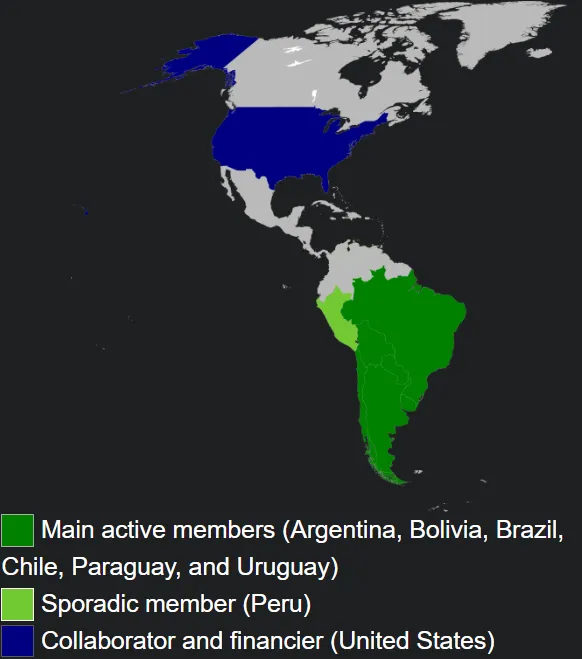
In the 1970s and 80s, the US supported Operation Condor, which officially started in 1975. The operation was a secret coordination of repression and the sharing of intelligence between the military dictatorships in South America. It included intense persecution of leftists and opposition to the governments, with 80,000 murdered (many of them being people simply disappearing) and around 400,000 tortured. Compared to other events, this might seem like a relatively low death count, mainly since it is spread across multiple countries over many years. Yet it’s insidious in its danger, in that if you kill a large group of people at a time, it will create backlash. Yet if you slowly assassinate and torture, this breeds a culture of fear that makes the backlash stop on its own. Which my very own country supported by the creation, as well as providing resources/intelligence.
https://www.cels.org.ar/especiales/plancondor/en/#condor-i-ii-y-iii
https://latinxhistory.com/history/operation-condor
El Salvador in the 70s (and before) was characterized by extreme inequality, with a small group of elite landowners controlling the economy/politics. Any attempt at reform was labeled as communist and dismissed. Thus, the Farabundo Martí National Liberation Front (FMLN), a leftist guerrilla group, arose in the early 1980s, declaring war against the Salvadoran state. The US, in reaction, provided over $4 billion over the next 12 years of war, along with tons of weapons, aircraft, and training. The El Salvadorian state during the war engaged in terrible violence. Take the 1981 El Mozote Massacre, where an El Salvadorian battalion backed by the US murdered hundreds of villagers in cold blood. The war ended in 1992 through a peace deal, yet of course (like all of these) has had lasting effects on El Salvador.
https://stewardshipreport.org/el-salvadors-forgotten-war-and-americas-hidden-role
https://www.nzz.ch/english/us-role-in-el-salvador-war-revealed-by-new-testimony-evidence-ld.1625008
https://www.dwherstories.com/timeline/u-s-intervention-in-el-salvador
Nicaragua was ruled by the Somoza family for 44 years, full of corruption, inequality, and suppression of opposition, while also keeping close ties with the US. In 1979, the leftist Sandinistas popularly overthrew the Somoza regime, implementing land reform and improving literacy. The US then supported the Contras, a right-wing paramilitary group, in attempting to overthrow the Sandinistas. The US provided tons of military support and implemented an embargo that devastated the Nicaraguan economy, services, and infrastructure, along with 30,000 deaths. In 1990, an opposition government won the elections, leading to peace talks and the end of the war. Congress actually passed laws during this time (1982-84) to block sending aid to the Contras. To get around this, Reagan and Lt. Col. Oliver North illegally sold weapons to Iran, which was under an arms embargo at the time. They then used the profits to fund the Contras. The revelation of this became a massive scandal known as the Iran-Contra affair. Oliver North now goes on Fox News as a commentator.
https://www.britannica.com/event/Iran-Contra-Affair
In Honduras, the US used the country as a base of operations in the fight against the Contras. It also trained/funded units that then carried out political assassinations/disappearances of leftists/critics.
https://rightsaction.org/emails/back-to-the-past-in-honduras-us-backed-death-squads-in-honduras
Skipping the US Grenada invasion which you can look into if you want, as there was at least a very slight justification although it should still be condemned as it was in the UN (108 – 9).
In Panama, General Manuel Noriega ruled as a dictator from the 1970s with the support of the CIA. In the mid-80s, Washington no longer liked him because he was involved in drug trafficking, corruption, and had relationships with some US enemies (like Cuba). In 1988, he was indicted by two federal grand juries on drug trafficking charges. The US embargoed Panama and froze his assets. Noriega lost the 1989 election but remained in power through the use of the military. After a US Marine was killed at a roadblock in Panama City, the US invaded with heavy attacks in dense areas. This led to around 2,000 civilians deaths, with later declassified documents/journalism finding evidence of hidden mass graves. The US then installed a pro-US president (at a US military base, lol).
https://en.wikipedia.org/wiki/United_States_invasion_of_Panama
https://www.jstor.org/stable/45316500?seq=5
In 1990, Haiti held its first democratic election after decades of dictatorships backed by the US. Jean-Bertrand Aristide, a left-leaning Catholic priest with 67% (lol) of the vote. Aristide sought military reform, elite corruption reform, and raising the minimum wage. Soon after, in 1991, the military, under General Cedras, overthrew him. The army and a supportive paramilitary death squad FRAPH killed thousands of Aristide supporters. The US publicly condemned the coup secretly cooperated with the military regime. Members of FRAPH were on the CIA payroll.
International pressure due to massacres and refugees forced the US to act. A diplomatic mission got Cedras to step down, and the US sent in troops without engaging in any combat. Aristide was restored, but under strict supervision. Specifically, the US and the IMF protected the military and forced Aristide to implement neoliberal reforms, including wage suppression and privatization. Aristide called it a “financial occupation”. Nevertheless, he remained in power, winning reelection in 2000. Then, in 2004, he was overthrown in a coup by the Haitian military/elites, with cables revealing the CIA was likely involved in supporting the coup. Aristide “resigned” and was flown to South Africa, although Aristide claims that the US essentially kidnapped him. The US, in coalition with other countries, then sent troops in (Operation Secure Tomorrow). In summation, it failed and hurt Haitian democracy while empowering bad actors.
https://thegrayzone.com/2024/03/01/secret-cable-cia-haiti-coup
https://haitipolicy.org/2004/01/haiti-crushed-by-u-s-power
https://africannugget.com/haitis-historic-debt-crisis-a-legacy-of-coercion-and-control
I’m not going to go into Afghanistan in detail, as I suspect you are already aware of it. Nevertheless, the invasion, spurred by post 9/11 fervor, was done extremely poorly and led to around 60,000 civilian deaths, not even including the trillions spent on it, only for it to “fail” in the end with the Taliban’s return in 2021.
This summer, I will be traveling to Iraq to conduct in-depth research on the US role in Iraq, and I believe it deserves its own section, so I will skip that for now.
In 2009, the military successfully staged a coup against the mildly leftist democratically elected president of Honduras, leading to abuses like assassinations and suppressions of protestors. It was widely condemned, and although the US publicly condemned it, they continued AID and did not formally call it a military coup. This was likely due to fear of strategic and economic interests, such as business elites opposing the former president’s minimum wage increases.
https://thegateuchicago.com/2016/05/30/how-to-hide-a-coup-the-us-role-in-the-2009-honduran-coup
Here is a list of additional abuses/ failures regarding US foreign policy, which I encourage you to research on your own, but I will omit here for the sake of time.
- Lebanon 1958 set a bad precedent against what the people of Lebanon wanted
- Supported dictator Said Barre in Somalia despite massacres and torture (1978-1989)
- Supported UNITA rebels in Angola despite atrocities by their leader, Jonas Savimbi (1970s)
- When South Koreans protested for democracy in 1980, the US approved of the military using force, which killed hundreds
- In Liberia, supported Samuel Doe in and after his 1980 coup despite ethnic mass killings AND later did not care about, and likely even helped, Charles Taylor rise to power, who would go on to commit horrific crimes (just read his convictions on Wikipedia).
- Lebanon 1982-1984 was a failure that radicalized Hezbollah
- Mistreatment in Iraq in 1991, with targeting civilian infrastructure and sanctions that led to the death of tens (if not hundreds) of thousands
- Somalia 1992-94 – Just peacekeeping/food was fine but eventually became a terrible mission (Black Hawk Down, US indiscriminately firing on crowds)
- Colombia in the 1990s – US military support went to right wing militias and destruction of peasant/indigenous crop systems
- Supported the Algerian military junta in 1992, which led to the military’s current control of Algerian politics
- Supported Paul Kagame after the Rwandan Genocide despite ethnic massacres in Congo
- Failed coup of Hugo Chavez (2002)
- Backing the 2006 Ethiopian invasion of Somalia (which created a radical Islamist group)
- In Syria, where we had different groups fight each other unironically that were supported by different US branches, as the FSA, backed by the CIA, and the SDF, backed by the Pentagon have fought multiple times (Syria was/is a mess to be fair)
- Failure in Yemen (2015-present)
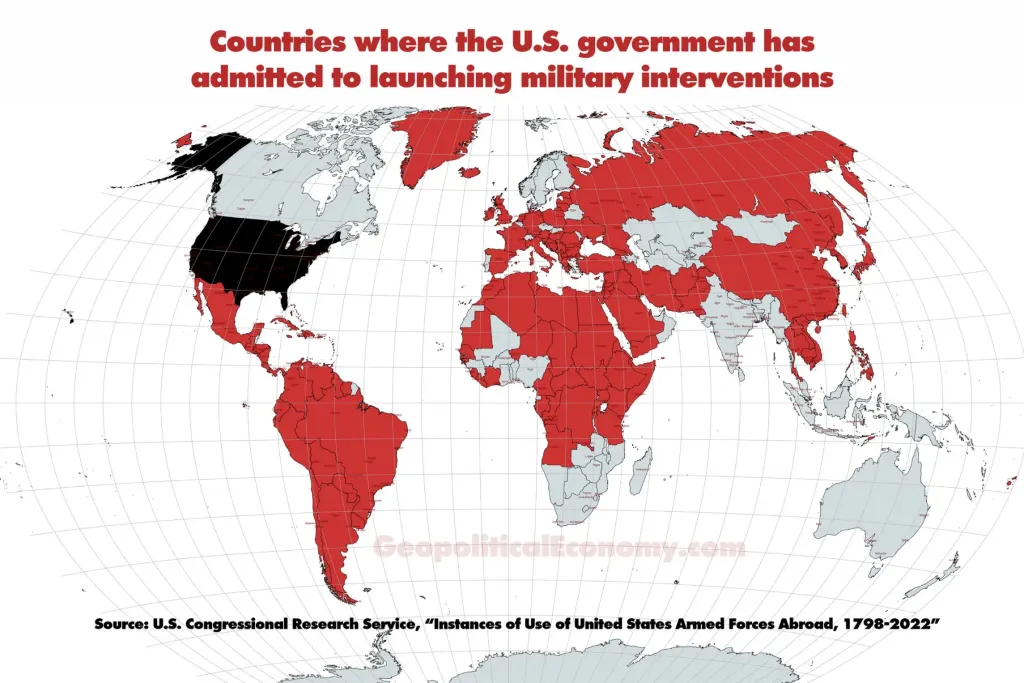
And this is all just the obvious stuff. There have been decades of secret deals, economic pressure, and intelligence operations that shaped a world order designed around American dominance. It’s a world where the dollar is the reserve currency, global markets are mandatory, and U.S. interests define what “freedom” and “stability” mean.
The US military/navy, after World War II, allowed for a system of international trade, as the US essentially became the policeman of the world and reduced piracy. Today, this means that the US has 800 military bases around the world and spends by far the most on its military. This military (usually) does not act in a just way, instead exploiting lower income people to enforce US elites interests (oil/control of financial systems).
The irony is, when people join the military, they often do so because they want to help others. The military found that when soldiers volunteer to help disadvantaged children where they are stationed, it boosts morale tremendously. These programs were found not to be helpful to the kids, but the military continued to use them anyway because they provided such a significant moral boost. I hope that one day, funding for military control will decrease, and we can instead allocate more resources to actually helping kids.
In total, the tragedy is not only that the US perpetrated all of these terrible acts, but that it continues to do so, and continues to act as the military and global center of justice for the world, which it is in no position to deserve.