Section 4: Random ideas
On Security Cameras
- created
- to be added
- status
- draft
Security cameras are an interesting concept. An omnipresent being able to see all and capture all, acting always at the end of the day based on the Law. Security cameras have no doubt allowed us to track down rapists, thieves, and, as seen recently in the case of Luigi Mangione, murderers in record time. So why am I not so keen on this seemingly useful eye?
To understand, we must start with Micheal Foucault’s 1975 book Discipline and Punish. Foucault laid out a progression in the forms of state power and law from a feudal society to an industrial society, sovereign to discipline society in Foucault’s terms.
Sovereign society is broadly the will of the king. Here, the law and the will of the king are the same thing, and a violation against either is viewed as one in the same. The punishment here is revenge (seen as “eye for an eye”) for acting against the will of the king.
Mostly developing after the Industrial Revolution, Foucault noted a shift to a “disciplinary” society. Here, instead of the threat of revenge and loyalty to the king being the preventor for broad “crime”, the preventor shifted to two things: individual expectations and institutions.
Individual expectations created a society that normalized judgment. A standard of what a person engaged with society should be, act like, and what “category” they should be in (Foucault expands on this in Madness and Civilization). It should be noted that, of course, feudal society had judgment, but these traits were both changed, more widespread, and standardized in disciplinary society.
Institutions act as a preventor for unlawful actions by implementing power upon civilians (although not traditional power). For example, prisons changed from acting as revenge to being for rehabilitation. Instead of someone blaming the king for imprisoning them, they instead direct their attention to the rehabilitation system. Schools act as a form of indoctrination, as while literacy and general education are undoubtedly taught, they also condition the subject to submit to the professional’s will. This is a common connection between Foucault’s examples, as conditioning expectations to the professional’s will is used in schools, factories, hospitals, and prisons.
All of these expect the individual to behave according to common standards, such as medical, legal, or educational. These common standards are also imbued into factory work, where each person has their own job and seat and is expected to remain in their seat in their standard time. In contrast, the feudal peasants can farm the grain however they would like and, incongruent with what many people think, can generally do what they would like as long as they meet the required quota of grain. Obviously, this required intense brutal labor and a terrible quality of life, and if the required grain was not met, punishments would follow. This is not a Evolian pro-fuedal argument, he is just pointing out the standards of labor.
All this led to a decentralization of power. Instead of blaming the troubles simply on the King and his feudal system, one has a choice between their doctor or the military or police or boss or corporation or a specific branch of government or specific party etc etc.
Yet here is where it gets really interesting. In 1988, Deleuze published an essay called Postscript on the Societies of Control. Continuing Foucault’s work, Deleuze argued that disciplinary societies had progressed to become societies of control. Here, they no longer expect self-regulation from the individual, as it is auto-managed.
Deleuze argued that in disciplinary societies if the individual decides to protest or act illegally against the system, there is little the law can do besides react to the individual’s actions. On the other hand, control societies don’t have to condition people (although he said they still do), as data prevents the crimes anyway.
I will give some examples. Let’s say you wanted to hijack a plane in the 70s. While not easy, it was definitely possible as the prevention system was pretty limited, instead simply hoping that most people would choose to remain stable members of society so as to keep the number of hijackings low. Now, for obvious reasons due to 9/11, even if 10x as many people wanted to hijack a plane as in the 70s (which thankfully they don’t), technology, security, and identification data within passports prevent that.
You can apply this logic to a lot of things. Fraud and identity theft are much harder to do, due to better control systems in place. Online data can automatically create our watch history, which goes on to define us, and monitor us automatically for illegal activities (it is limited, though, but a better control system like China regulates the internet more intensely). Data can define our categories, such as with test scores, GPA, performance reports in jobs, or debt with our credit score.
All this is epitomized in the security camera.
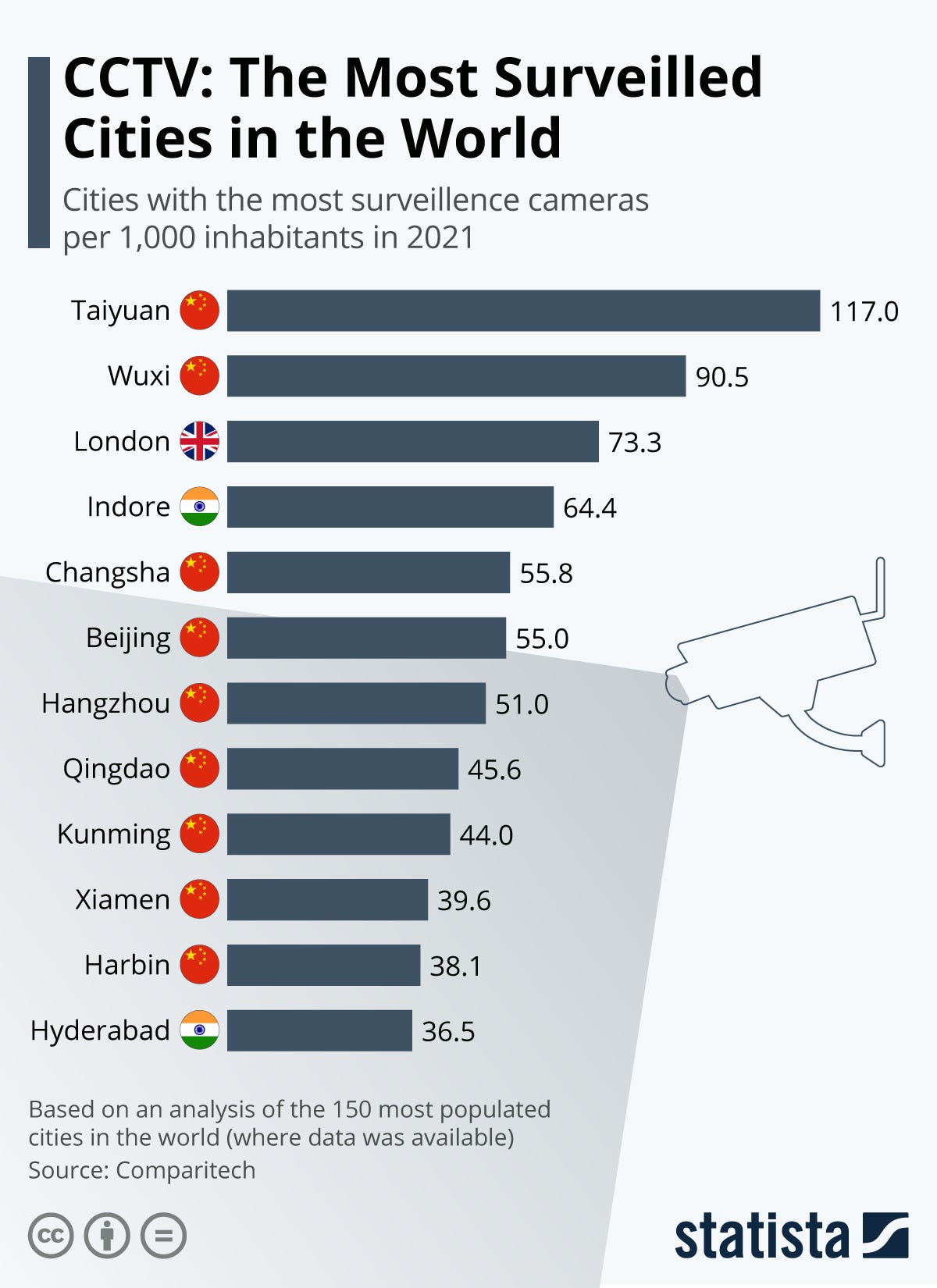
The camera brings a reduction in crime, no doubt. Yet there are a couple of problems. For one, it is not actually a true solution. If people wanted to rob a bank before, security cameras remove the ability. The thing is, those people still may want to rob a bank, just now they are angry because they have no chance at doing it (this is a bit of a stretch, but you get the point). Security cameras don’t address the root of why people want to commit whatever crime they do, and while they are a good deterrent, we must work to address the first part in tandem.
Secondly, it simply removes privacy. I won’t expand on this as it’s pretty self-explanatory. Whatever you think of privacy as, security cameras don’t help your personal privacy.
Thirdly, we can play whataboutism and imagine future societies. In China, the people have mostly been fine with high levels of security cameras because they are more of a collectivist culture, the idea that anyone scared of security cameras must want to break the law, and the people have had quality of life improvements. But what happens if market failure, food production failure, or even war decreases the quality of life, and people want to protest? Better yet, think of an AI data dystopia where AI surveils cameras, releasing police robots or something similar upon a broken law. It is, of course, a made-up scenario. Yet this technology is not far off and could theoretically be implemented now.
This is all speculative, but the point is this. In no case will government-run security cameras be on the side of social change. Even now, protests must be coordinated in advance with the police. My worry is that in a case of true social breakdown, security cameras are a part of the system that would prevent the necessary change from occurring.
We can apply this to the Luigi Mangione case. Here, a healthcare system that hurts millions of Americans every year received an assassination of a CEO at one of the worst companies. I must first acknoledge that in no way am I defending murder, this is simply analysis. Most know these companies make huge profits off of suffering Americans. One can imagine a world without security cameras and advanced technology in the law and that similar assassinations would likely be more common. It is because assassinations similar to the one on December 4th are a jail sentence for whoever does them, as the only real chance of escape is leaving the country to never see one’s family again. Even then, it’s a gamble. The technology is at the point that it can track down the assailants in a matter of days, as seen in Mangione’s case. Thus, in combination with a lack of means to protest healthcare costs, the true discontent is hidden. It is only after the killing that the discontent is revealed.
The generally positive response of the public shows that people want change, yet they have no way to access this change and thus will accept assassinations. We can also see the rise in Unabomber or extremist political affiliations online as a rise in the demand for change, ironically through data that is “controlling” them.
A final problem with security cameras is the removal of mild rebelliousness or urban legends. For example, in the 1960s a cow was supposedly put onto my school’s roof as a senior prank. If this were to occur today, everyone may have a chuckle but then the perpetrators would be found out and suspended, if not expelled.
I don’t think cameras are necessarily all bad. Again, we should use this tool to catch rapists and the like, and I think certain jobs could utilize well-implemented security cameras. For example, currently, art museums require staff that simply stands around all day, telling people not to get too close. I assume that this would be an extremely boring job after a bit. We could simply have a camera in the room that does the same thing. It’s a little more creepy, but I see little need for civil disobedience in art museums, and the civil disobedience can still occur regardless of the cameras.
One last thing to note is that disciplinary society is failing. In my school, nobody except the teachers stands for the pledge. Military recruiters have consistently under-recruited for years on end. Trust in government and media is not high, to say the least. These represent a failing of the political institutions, which should be corrected with change.
But if data can regulate civil disobedience that would cause change, what does it matter if people are angry to those in charge?