Section 4: Random ideas
On Drugs
- created
- to be added
- status
- draft
The word “drug” in its modern form means very little. Caffeine is a drug, and so is DMT. Tylenol and meth are both drugs. Psilocybin is just as much of a drug as Adderall. My point is that this is too wide of a range for something that has a very real influence on policy and the lives of people around the world, and I propose that we differentiate drug policy much more specifically and based on the individual harm and addiction level of each drug.
To start with, an important point is that no matter what these are still drugs. When talking about something that billions of people take and that can impact our bodies, it’s important not to focus on specific cases and instead on the macro. People can die from basically anything, so bringing up how this specific drug led to a specific death, even if it’s tragic, is not really productive. People die from caffeine, but we must have nuance.
The most important thing to me regarding drugs is how addicting they are. When looking at deaths due to drugs, very few people die from their first time using a drug. I assume that of 2025s 108,000 overdose deaths in the USA, most came from people who repeatedly used drugs, either leading to an overdose on fentanyl or the addicting drug. It’s true that some people tragically will die due to taking something laced with fentanyl, which is no doubt a problem, but this makes up a small percentage of said deaths.
Almost every major problem you can think of with drugs traces back to addiction. Since addiction is something that hijacks the brain to prioritize the substance at the expense of the users perceived free will, it can be reasoned that policy should deter use of substances with addictions attached. This is essentially due to the irrationality of a user, as well as how ignorance is bliss. Once someone has experienced meth or cocaine, if their brain enjoyed that substance, as many do, then their life is changed. That experience/(experiences if they continue to use) will remain in their brain, and use will create harmful problems.
For a thought experiment on addiction, try not to eat any sweets for a week. No candy, sugar, ice cream, or even things with high added sugar like ketchup. Also, replace your fruits with vegetables. For many people, this task is pretty hard. Now imagine that but basically with cravings 10 or 50 times as strong, and you have certain drug addictions (kinda).
What is important is that addiction should be viewed differently in a policy standpoint. Instead of treating users as a criminal, drug policy should see those suffering from addiction as having a medical problem. In order to not treat the user as a criminal, users under a certain quantity of a (harmful) drug should not receive a criminal record and may instead, depending on the circumstance, likely be required to receive treatment. If a person has an abnormally large amount of a drug, then they should possibly receive stricter punishments, especially if it can be determined that they are producing/selling the drug.
In regards to non-addicting drugs, primarily psychedelics, users should not have to receive treatment and should only get into trouble if they do something that is already illegal, such as for example stripping naked and running around. Producers of psychedelics may still receive punishment, but this should be much more relaxed. I stick to decriminalization and not legalization because buying psychedelics in a convenience store would not be reasonable in current society, although perhaps it would be in the distant future. Psychedelics could be treated as a real drug and be prescribed by a doctor, with special treatment centers where users can safely use the substances. This already exists for drugs like ketamine and sometimes MDMA (although MDMA has more downsides than drugs like LSD or shrooms), and they have proven themselves able to help people recover from harmful mental problems such as depression, addiction, and PTSD. In regards to addiction, Ibogaine is EXTREMELY promising and should be made medically legal and studied more.
Prescription psychedelics may sound questionable to some, so let me explain. Psychedelics were criminalized in the 60s in order to diminish the mindset of the hippies, as psychs cause people to question the state of the world and their own preconceived notions. Yet thanks to medical research, we have discovered that if used in safe set and setting, psychedelics are some of the safest drugs out there and can allow people to have beautiful and thoughtful experiences that change their life for the better.
They are still drugs, so I should acknowledge a few things. For one, sometimes people will have “hard” trips, however this mainly points to the fact that they are not just mind numbingly pleasant and the user has to treat them with respect. Psychedelics do not cause schizophrenia, however scientists think that if someone was genetically determined to develop schizophrenia later in life, then in rare cases psychedelics (or even weed) can trigger it early. Basically if you have parents or aunts/uncles have schizophrenia, I’d wait until at least 30. Finally, around 1-3% of psychedelic users develop hallucinogen persisting perception disorder (hppd). This causes purely visual effects that can possibly be mitigated, although it can be quite harmful to some people (Andrew Callaghan has a good interview about it if you are curious). It seems to come in people who use when younger and/or frequent users, although the science around it is not that clear and should be expanded upon. It can also happen rarely in users of SSRIs or weed.
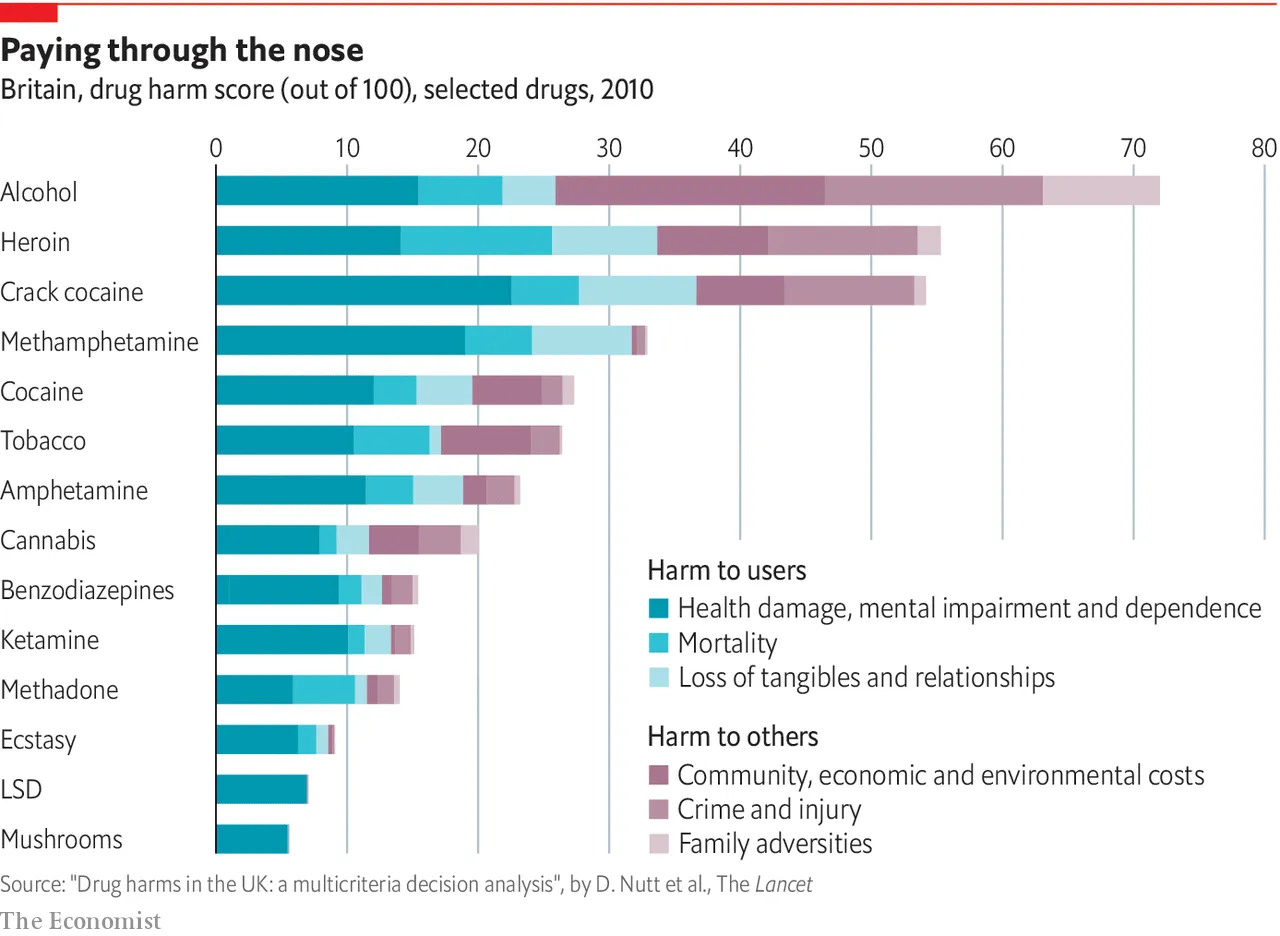
The Economist is not my favorite but here is a better understanding of the per capita harm by drug.