Section 1: General opinions on political topics
Interesting Potential Ideologies/Ideas
- created
- to be added
- status
- draft
During Quarantine, I found myself on a side of TikTok called poliTok. Politics here was less confined to binaries or political thinking, with a wide range of ideologies. Minarchists, Mutualists, and Eco-fascists all interacted, and I think it made me open to a wide range of ideas. Humans are often a product of their environment, as seen in how social experiments can yield widely differing results depending on the culture in which they are conducted. There’s no definite correct political solution, so we should be open to new ideas.
Here, I will simply list ideas that I am at least somewhat open to, all of which could be meaningfully incorporated into policy. It doesn’t mean I agree with everything, just that the more creativity we introduce into the political system, the better we can find solutions to our problems.
Decision making structures
Technocracy: The general idea that, in some form, prioritizes technical experience over, for example, charismatic or well-connected people. If you want to partly understand China’s rise, consider that many on the Politburo (the top of the CCP) are engineers.
Cyberocracy: This is the general idea of a government with “rule by information”. It would likely involve systems of computer networks (or AI) that serve as a fundamental antithesis to traditional, slow bureaucracy.
Sortition: Positions selected by lottery rather than election, aimed at reducing elite control and increasing representativeness. You could have randomly selected members spectate on local government decisions, similar to jury duty (though you could opt out without consequence). Or you could have local posts held but random members of the community at different times, as long as there is significant checks and balances.
Ownership/Production models
Socialism: This is important to understand (in a basic manner), given its widespread influence and common misunderstanding. You are dependent upon means of subsistence, mainly food, water, medicine, and clothes. These things are made from means of production, such as land, tools, and capital. Under Capitalism, means of production can be privately owned (notably, it has nothing to do with your personal possessions like a toothbrush). Due to the fact that you do not likely own all the means of production required to make all your means of subsistence, you are thus required to participate in the labor market. Furthermore, when you work at a job, the wage does not represent the full value of your labor, due to the fact that your employment means the company has deemed you profitable to them. This generates further wealth for the company’s owner, wealth based purely on your labor.
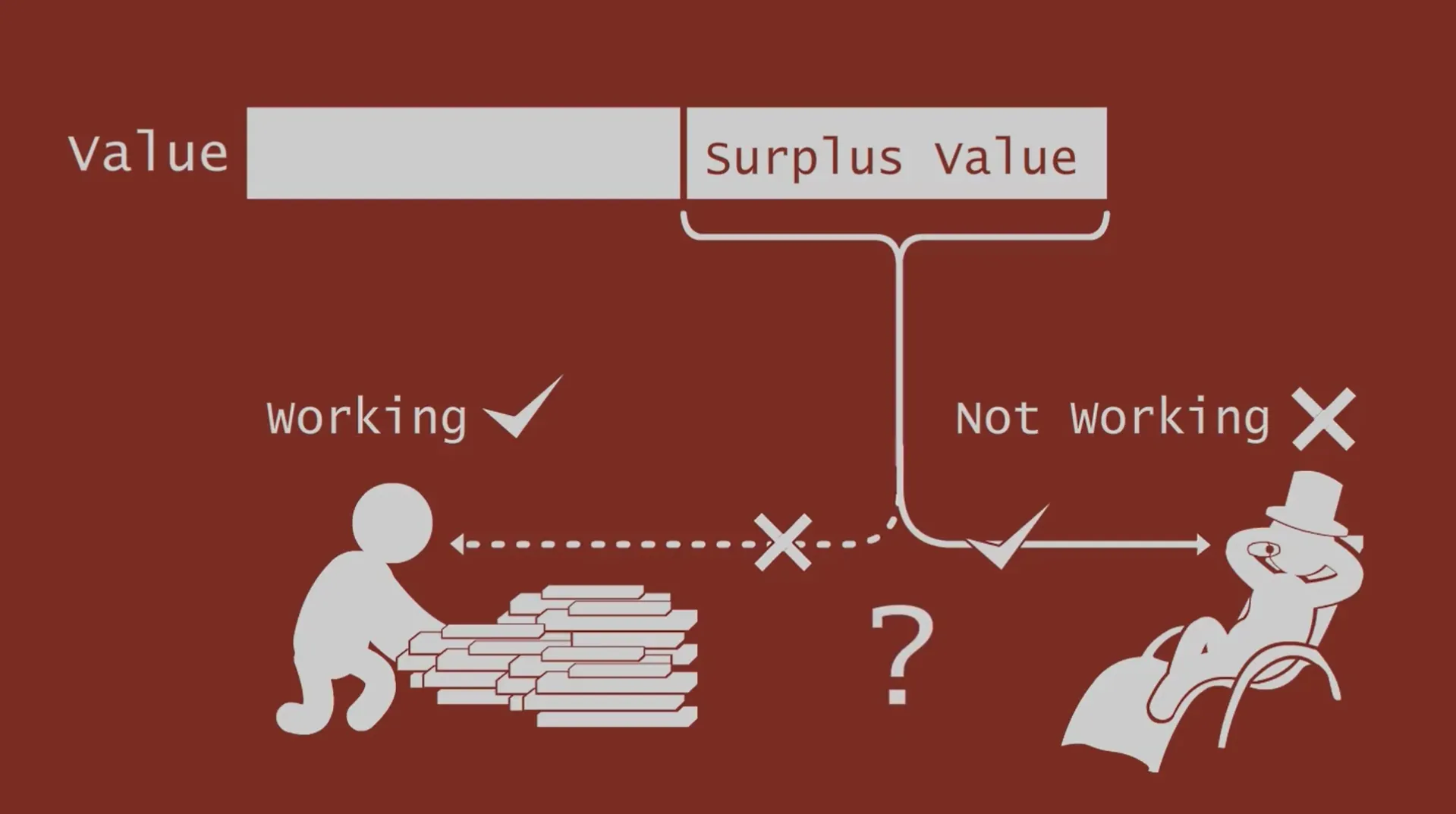
This is only an extremely brief overview of Marxism/the labor theory of value, with Socialism as the political philosophy behind it. The problem with defining Socialism is that it is such a widely used term that it’s hard to say it has a specific meaning beyond a form of left-wing politics at least partially inspired by Marxism, focusing on the distribution of the means of production. For those completely skeptical of anything related to socialism, I understand. We have grown up in a culture of Capitalism that only knows Capitalism, and thus it is hard to even conceptualize other systems working. Not only that, but much of our daily lives is based on what those at the top determine (news programs, movies/TV, education systems), and those at the top are often supportive of capitalism, whether liberals or conservatives.
The thing is, our system is not “true” Capitalism by any sense of the word. There is markets, yes, but these markets are regulated by the state and have fallible human input. Any true Capitalism, especially in the age of automation, would collapse into neofeudal social conditions without the amenities that the private sphere has no profit motive for (public transport, legal systems, park services, etc.). Then we can ask, what do we need markets for? Of course, basically any products we consume are sold through market-style systems. This is not inherently bad, as markets provide indicators for how much people desire different items.
The problem is that: A. we are only human and thus we can arguably be corrupted by our desires, as they are not always rational (slop/fast fashion/drugs), and B. markets also lead to capital consolidation. Capital consolidation could be traced to the impact it has had on many of our current problems, such as corporate influence in government, general unaffordability, and more. With these obvious problems, we can ask: What if we could use computer-based technology to create smart, people-driven planning, with universal safety nets, workforce democracy, and market elements for coordination and entrepreneurship? Again, you may be skeptical, which is fine, and I am skeptical of elements too. But I think with modern technology, the human species is capable of a lot and potentially more than we can currently imagine possible.
Distributism: This is a Catholic political philosophy opposed to both socialism and capitalism, instead advocating independent craftsmen, family-owned businesses, worker cooperatives, member-owned mutual associations, and guilds. It advocates vigorous antitrust laws and systems of redistribution and opposes private banking, instead preferring mutual banking, such as credit unions.
Mutualism/neomutualism: Ownership in community-based and mutual credit systems is often used while retaining many elements of small-market systems. Neo just adds digital platform aspects to it. It wants to eliminate rent, profit, and interest (not as ideas but in how capitalist economies they can function as exploitative income).
Market socialism: Markets exist, but profits are often distributed directly to workers (there are some companies like this around the world to varying degrees).
Syndicalism: Worker control of the economy through in-depth trade unions that would replace capitalist firms and government bureaucracy. Lots more on this one, but I ask that you do your own research.
Georgism: This is a political philosophy based on the principle that the economic value of land/natural resources should belong to society, with the main proposal being a tax on the unimproved value of land. In traditional Georgism, this is the only form of taxation. While there are no doubt problems with this, Georgism definitely contains some smart ideas that should be further analyzed, with policy ideas such as in Sweden/Denmark, where land is taxed differently than improvements, arguably leading to urban renewal.
Coordination/Planning
Cybernetic Socialism: The incorporation of AI, big data, and computing systems into a centrally planned market system. Probably required for a modern socialist movement. Project Cybersyn in Chile (1971-73) was a good early example of this before the military coup.
Parecon: Local councils determine what to produce/consume through community participation. The government then calculates the environmental/social costs and the total supply/demand, and big data could effectively coordinate goods around. Also, people would have a wider variety of tasks than in their current jobs, meaning everyone would be engaged in both planning and repetitive tasks/cleaning.
Corporatism: This is where groups representing industry (agriculture, science, construction, etc.) negotiate policy within the governmental structure. It is not to be confused with corporatocracy, a political system dominated by business interests. Corporatism has a wide and varied history, including Plato/Aristotle, Christian religious societies, social corporatism, support from Pope Leo XIII (1881), Durkheim’s corporatism (solidarism, which is interesting in its own right), liberal corporatism, fascist corporatism, and neo-corporatism.
Neo-corporatism: This is an explicitly democratic/modern form favoring Tripartism, with strong labor unions, employers’ associations, and the government all cooperating to create policy.
“Neosocialism”: Basically, strong social democracy, with markets and capital, but adding social welfare and possibly UBI. Also things like decommodifying essential items and pushing back against capital. (Don’t think of this as Socialism but as its own thing tbh)
Scale/Structural
Communalism: Decentralized, direct democracy, eco-communities linked through confederal councils.
Bioregionalism: Organizes society around the natural environment of one’s place (i.e., local crops) rather than, for example, around relatively artificially drawn national borders.
Panarchy: When originally proposed, this meant governments would act more like churches that one could join and leave, with multiple governmental systems within a territory. In the modern world, I would propose that we adapt this to just mean more political experimentation and different forms of governments (within reason) within one country. For example, if a part of the US wanted to experiment with and implement, say, a corporatist style of government and another neo socialism, it should be allowed in the name of experimentation. The basic requirements would be A. the free ability reasonably leave the territory, B. certain social laws, for example, a segregationist or legalizing pedophilia government wouldn’t be allowed, and C. making sure there is not an exploitation of the system to get around, say tax laws or something. Obviously, this would be hard to do, but it’s the general principle.
Value based ideas
Post scarcity economics: Arguing that technology can/should eliminate material scarcity to allow for human flourishing.
Degrowth: Reduce production and consumption, especially in wealthy countries, to help the environment and promote social well-being (away from consumerism). Also, it would mean less work in general, so more free time, as a general principle (if reformed correctly).
Open source government: Makes laws/policy clear to understand. This one is critical.
Climate federalism: Unite the world so as to fix the climate problems.
Temporal federalism: Represent future beings in government, or at least seriously take into account the problems our actions have on future humans.
Arab socialism/pan-Africanism: Movements focused on uniting shared cultural groups that have historically been beset by imperialism with lasting consequences. One could imagine a United States of Africa.
While there are many ideologies, many more than listed here, and I think if every politician had completely different views that would be too much, we nevertheless should be able to generally incorporate these ideas into common knowledge so as to broaden political debate.
Additionally, here is an interesting video on online politics that is somewhat along these lines.