Section 1: General opinions on political topics
On the Fertility Rate
- created
- to be added
- status
- draft
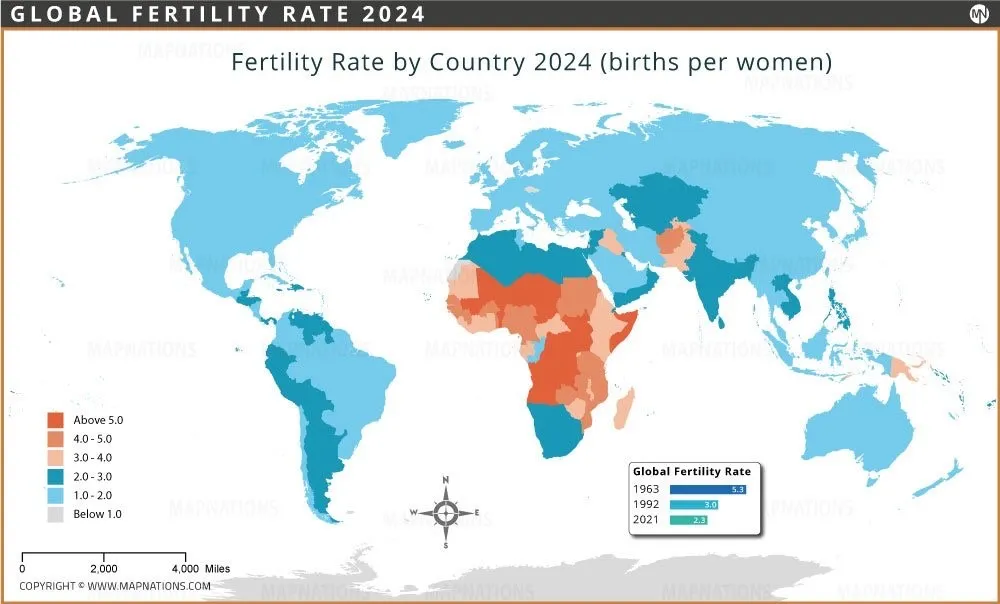
Here is a map of the worldwide fertility rate, with the current total rate around 2.25. The fertility rate, in its simplest form, is the number of births per woman. 2.1 is the general replacement rate, meaning that for every couple there would be 2 children, with the .1 to account for premature deaths.
When you actually examine the map, most of the world, excluding Africa and south/eastern Asia, has birth rates below 2.1. There is some general concern about what this will mean for the future, and it’s not hard to see why. Advances in healthcare enabled more births to survive, leading to high birth rates over the last 200-ish years. As women joined the workforce and raising children became more expensive, among many other country-specific and general factors, large families simply became both less attainable and less desirable.
There are two immediate “solutions” to decades of low birth rates, aside from increasing fertility itself. Raising birth rates is surprisingly hard to achieve (it hasn’t worked in Hungary, Russia, or South Korea, really) and is a much longer-term solution.
Assuming a country that does not pursue these solutions (which will be addressed later), we can first examine the potential problems of continous low fertility rates.
For one, our economy generally operates under the assumption that firms aim for higher profits each year, and thus a considerable downsizing of the consumer base of a market will may require changes in how markets are structure and how economic success is measured.
It also means much greater spending on the elderly, as the longer lifespans enabled by modern medicine will be unaffordable for many. This is in addition to a higher and higher percentage of the country being elderly, which has negative effects on healthcare systems, pensions, and public finances.
This applies directly to social security around the world, which will require more funding and/or a reworking, as there is a lower percent of workers to support a higher precent of retirees.
There are basically so many changes that it is hard to predict, with more severe changes for countries with lower birth rates. For example, here is South Koreas population pyramid.
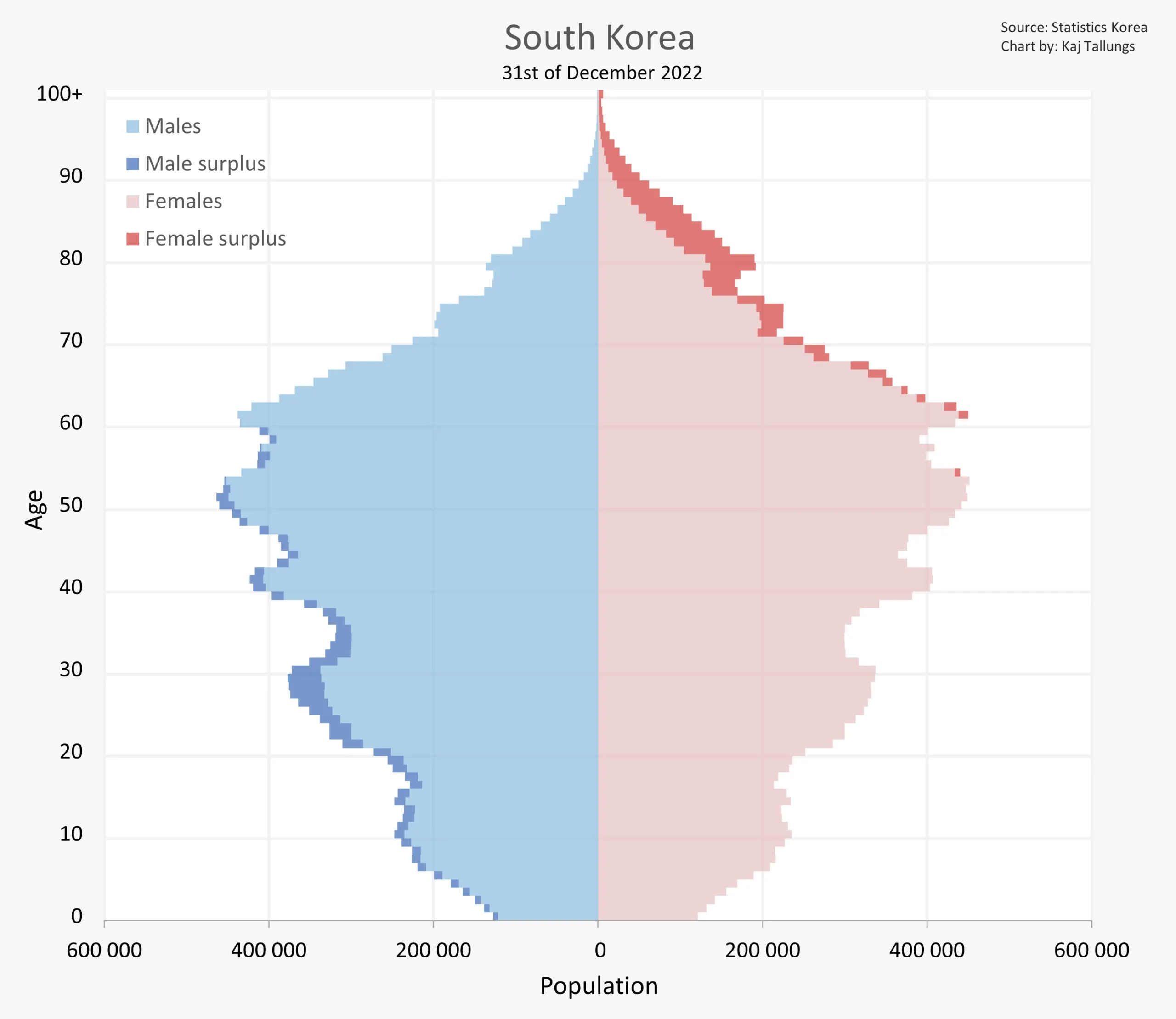
Increasing birth rates is much harder than one might think. Birth rates are very cultural, so changing them takes quite a while. In addition, using policy to decrease birth rates (China, Iran) is easier than the opposite as decreasing removes pressure on the economy/households with less mouths to feed and economic growth per capita required. Increasing does the opposite, which is why even when countries offer large benefits for kids like in South Korea, Singapore, and Hungary, it has very little change.
Using South Korea as an example, countries have basically two solutions. The simplest one is immigration, which allows Western countries that have long had fertility rates below 2.1 to remain stable in terms of population. The other is robots and automation, which have many fewer downsides if enacted accordingly. In fact, a country having a birth rate of, say, 1.3 to 1.8 could be beneficial overall under certain conditions. Large birth rates require large amounts of production spent on housing, agriculture, and infastruture, which can take away from economic satisfaction and make costs of living higher.
Part of why China was able to rapidly transform from a poor agricultural society into the modern superpower it is today is because of its one child policy, which allowed them to better focus on industry. This policy is and will have negative effects in the long term, but this is where robotics (and cutting bullshit jobs) comes in.
If done right, robotics can be implemented to reduce the workforce in line with the declining number of workers. This requires complete coordination between the productive forces and the government, as machines would have to coordinate the number of workers and jobs, and keep them in scale. It is somewhat of an argument for oversight of the job market, but with modern technology, this might not be as impossible as it may seem. It would definitely require high levels of transparency to make sure nobody gets screwed over. Yet again, if implemented correctly, this could reduce working hours and foster high levels of competition in the global economy by ensuring that all jobs are fully productive.
With an increase in the elderly population, robotics could also enable better care, providing more “eyes” on those who may be medically suffering but don’t have constant attention from nurses.
In addition, a lower fertility rate should be desired on the simple basis that we cannot grow forever on a limited planet, as well as for its less-stressful impact on food production.
Finally, in middle Africa, where birth rates are highest, people should be more highly educated in sexual education and have access to more contraceptives. For example, a vasectomy only takes around 20 minutes for the actual procedure, and some families may want to do such a procedure after 2 or 3 kids. In the long run, affordable, voluntary family planning would reduce the burden on governments and improve the standard of living for the population.